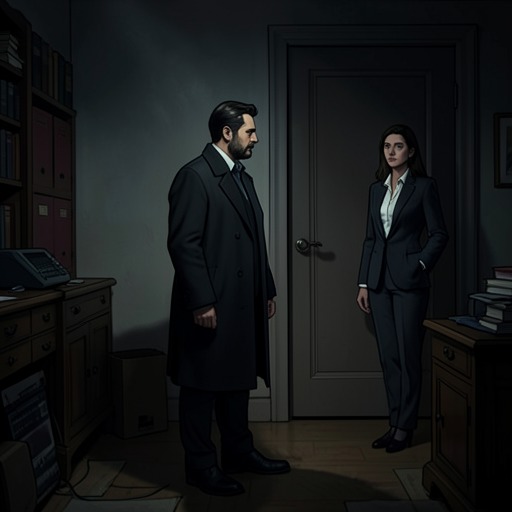
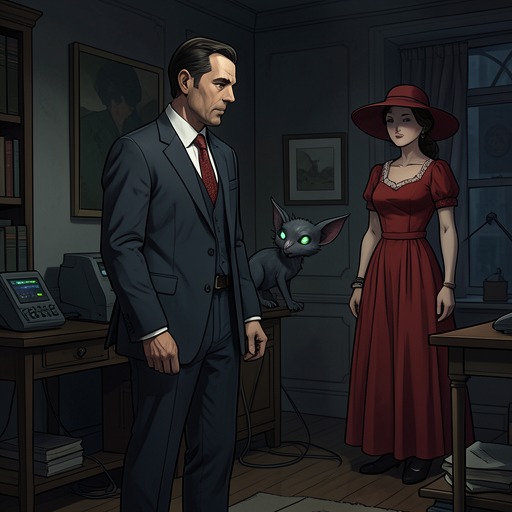
John Wellington–Humphrey Wells relationship
The Portable DoorJohn Wellington Wells and Humphrey Wells are uncle and nephew whose relationship becomes a struggle over the leadership and moral direction of J.W. Wells & Co. John distrusts Humphrey’s conduct and refuses to retire; Humphrey, unwilling to wait for control of the firm, plots against him. The conflict moves from concealed rivalry to an open demand for a talisman, then to the imprisonment of those who will not hand it over. Kinship gives the dispute its form, but the business and the means used to control it are its stakes.
Family Ties and the Dispute over the Firm
Humphrey is John’s nephew, but the family connection does not soften their opposition. John has spent a long time talking about retiring without ever doing so, and Humphrey has grown impatient with that delay. The account describes him as tired of waiting and plotting with two other partners to get his uncle out of the way. John, for his part, has no intention of giving up his position. His resistance is directed not merely at leaving office, but at the prospect of Humphrey taking charge of the business.
Their disagreement also concerns what kind of conduct the firm should permit. John regards the things Humphrey does as unethical, dishonest, and wicked; the two employees who later recount the conflict say that they share his judgment. This makes the rivalry more than a succession dispute. In their account, John’s objection to Humphrey’s methods helps explain why he will not yield control, while Humphrey’s impatience leads him to treat the uncle’s continued leadership as an obstacle to be removed.
The Talisman and a Failed Bargain
Before disappearing, John summons the two employees and entrusts them with a small, light magical object. He explains that it must be kept safe because it is the one means he believes strong enough to rescue and free him if Humphrey does something dreadful to him. The object can be carried in a waistcoat pocket or hung from a watch-chain, making its modest size sharply unlike the power John assigns to it. He has his employees keep it with one or the other of them at all times.
Humphrey soon makes clear that he knows about the talisman and wants it. In a private meeting, he offers the pair money, promotion, and partnership in the firm. They refuse every inducement. He responds with threats, but then unexpectedly tells them to leave, without using the magical force that they believe he could have used to compel them or harm them. At the time, they find his restraint extraordinary. It does not end the conflict: it postpones the consequences of their refusal while leaving the talisman beyond his reach.
Disappearance and Competing Explanations
Not long after entrusting the talisman to them, John disappears. The explanation circulated within the office is that a job for clients in the West Country went badly wrong, that the problem involved a love philtre, and that John had to be sacrificed to the Evil One to put matters right. The story further claims that the Evil One appeared and carried him away. These are the explanation the employees are given, not an established account of what happened.
John’s earlier warning changes how they interpret the disappearance. They do not accept the office story; they suspect that Humphrey has done something terrible to his uncle and understand the talisman as a possible means of reversing it. Their belief links the nephew’s earlier plot to the sudden absence, though the account does not establish precisely what Humphrey did to John or where John is being held. The uncertainty leaves the relationship defined by an unresolved question of power: Humphrey appears to have acted, but John’s entrusted object remains outside his control.
The Confrontation Behind the Imprisonment
Weeks later, while clearing the firm’s strongroom, the employees find a cardboard tube containing an india-rubber mat shaped like a door. They read its instructions and try the portable door, directing it to their lodgings. The destination proves incomplete: the real door connecting their rooms to the rest of the building is absent. When Humphrey appears in the magical doorway, the discovery turns their experiment into a confrontation with the uncle’s enemy.
Humphrey connects their refusal to surrender the talisman with their knowledge of his business. He tells them that it would be better if they were permanently out of harm’s way, then shuts the magical door. It vanishes, leaving them in a room with no door. The action makes plain why his earlier offers and threats mattered: when persuasion failed, he could use the firm’s magic to remove the people standing between him and the object, as well as those who knew too much. It also shows that his willingness to imprison them does not prove that he has recovered the talisman or settled John’s fate.
A Kinship Turned into a Power Struggle
The relationship is presented through the retrospective account of the two trapped employees, who distinguish what John told them, what the office claimed, and what they themselves inferred. That distinction matters: Humphrey’s conspiracy and demand are reported directly as events they witnessed, while the precise circumstances of John’s disappearance remain uncertain. The narrative thus places the reader alongside people who have strong reason to suspect Humphrey but do not possess the full explanation.
By the time Humphrey shuts the door, the conflict has widened from a nephew’s attempt to displace his uncle to a contest over the talisman, the firm’s secrets, and who can exercise power without accountability. John’s trust in his employees extends his resistance beyond his disappearance; Humphrey’s response turns their loyalty into grounds for confinement. The account leaves the uncle’s fate unresolved, so the relationship remains an active conflict rather than a completed succession: Humphrey has removed witnesses from the ordinary world, but the object intended to protect John has not been shown to pass into his hands.